Sour vs. Bitter Espresso Shot Diagnosis: Fixing Channeling, Gushers & Choked Pucks
Stop confusing sour under-extraction with bitter astringent channeling. Master the Salami Shot palate test, bottomless portafilter diagnostics, and ratio adjustments.
Reader-Supported Lab Note: When you buy gear or whole beans via links in this guide, we may earn an affiliate commission at zero extra cost to you. As an Amazon Associate I earn from qualifying purchases. Learn more.
⚡ 60-Second Barista Takeaways
- Organic fruit acids dissolve in the first 8 seconds; caramel sugars dissolve mid-shot; dry plant-fiber bitterness extracts last.
- Yield Ratio (1:1.8 vs 1:2.4) is your strongest lever for balancing sour vs. bitter—even stronger than 2°F water temperature shifts.
- Grinding TOO fine causes high-pressure micro-channels that over-extract a narrow tunnel (bitter/dry) while leaving 70% of the puck under-extracted (sour).
Extraction Sequence Physics: Acids First, Sugars Second, Tannins Last
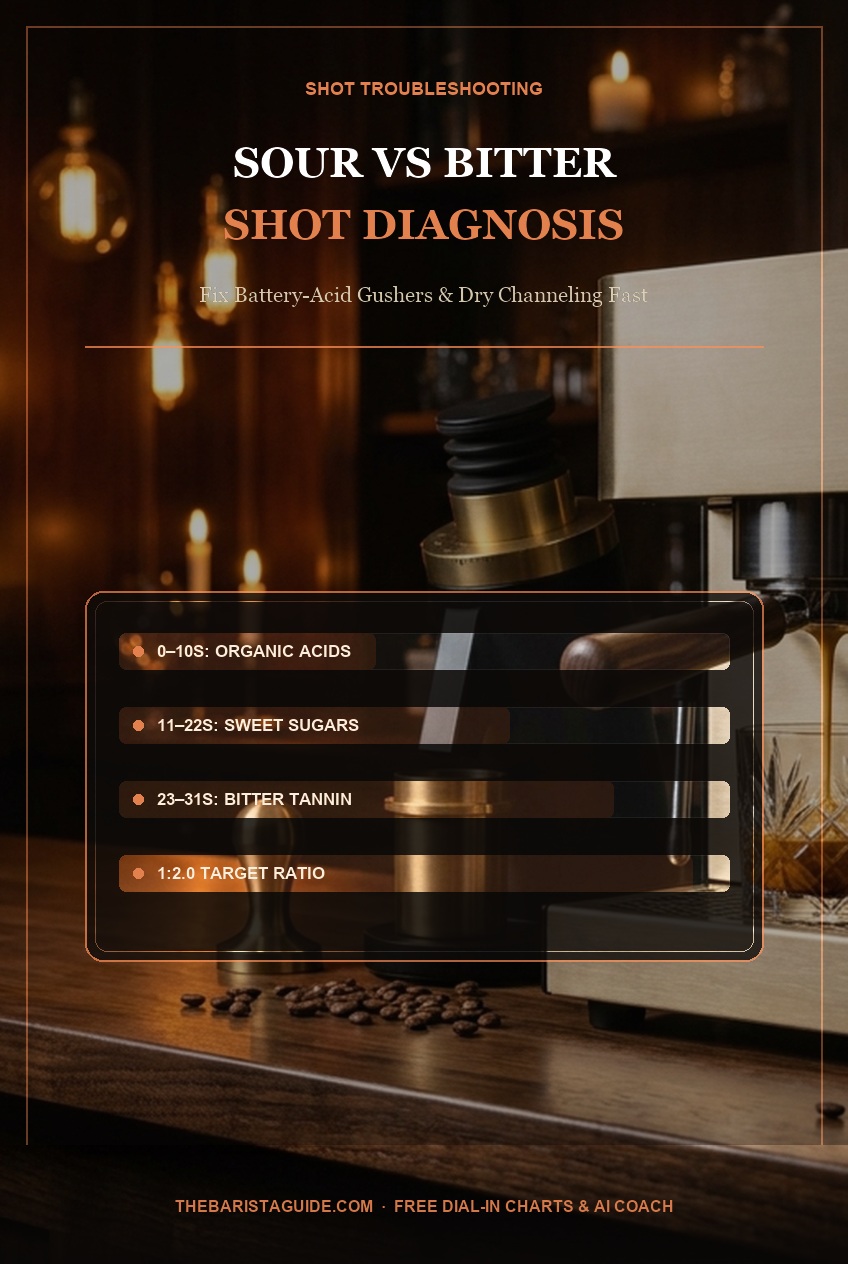
Every 9-bar espresso pull is a high-speed chemical race across 28 seconds. Because coffee compounds dissolve into hot water at wildly different molecular weights and polarities, flavor emerges in three strict phases:
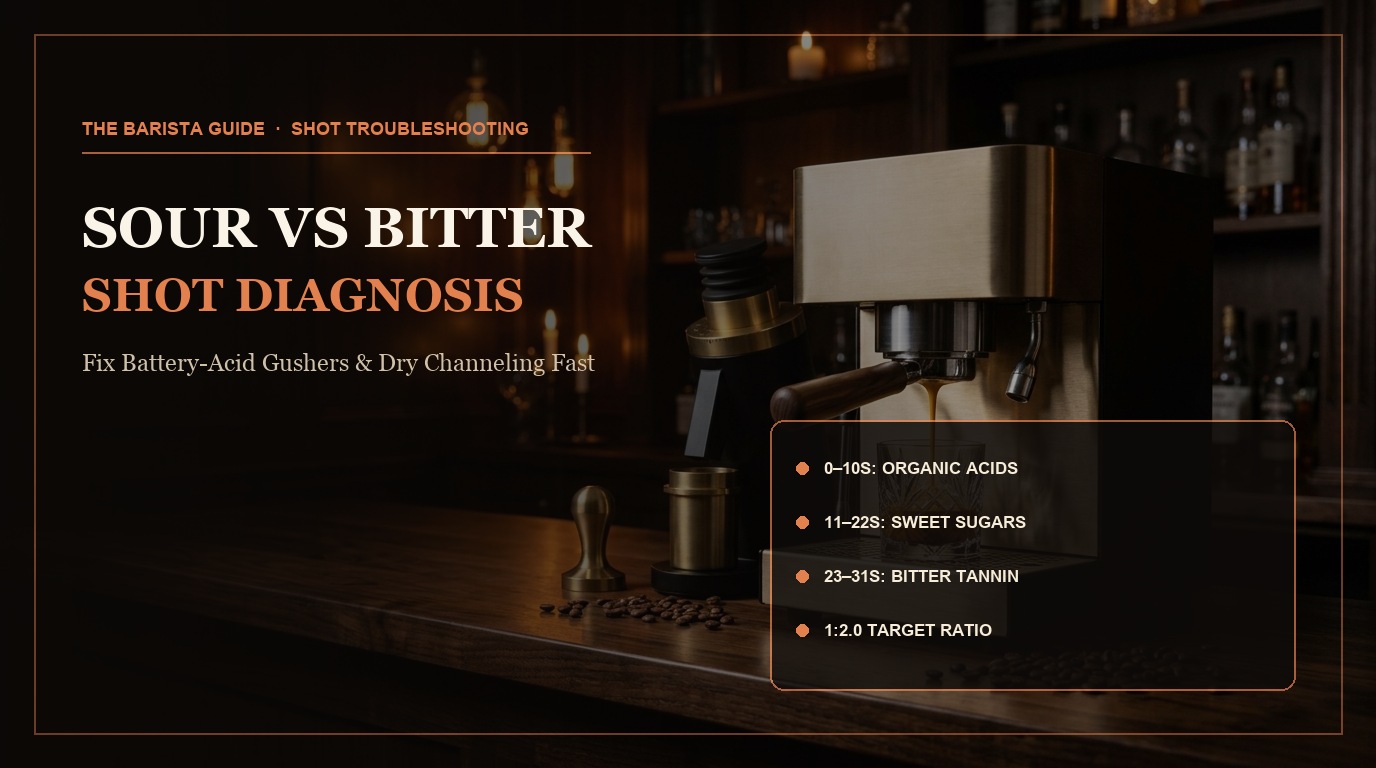
- Seconds 0–10 (Acids & Salts): Highly polar organic acids and caffeine rush into the cup first. Stop a shot here and it tastes sharply sour, salty, and thin, with rapid crema dissipation.
- Seconds 11–22 (Maillard Sugars & Oils): Caramelized sugars, melanoidins, and emulsified lipids dissolve next, coating the tongue in viscous chocolate, stone fruit, and honeyed sweetness.
- Seconds 23–32+ (Cellulose & Dry Phenols): Heavy woody plant fibers and chlorogenic acid breakdown products extract last—adding pleasant dark-cocoa structure in tiny amounts, or harsh, tongue-parching astringency when pushed too far.
Visual & Taste Diagnostic Matrix (Bottomless Portafilter Protocol)
Mount a Bottomless Naked Portafilter over a 0.1g Auto-Timer Espresso Scale and diagnose your exact symptom below:
| Cup Taste & Visual Cue | Root Mechanical Cause | Exact 1-Variable Fix | Tool That Solves It |
|---|---|---|---|
| Sharp lemon sour · Pale blond in 16s | Grind too coarse OR stale degassed beans | Grind 2–3 micro-clicks finer; stretch yield to 1:2.3 | Fellow Atmos Vacuum Canister |
| Harsh, hollow ash · Drips for 42s+ | Grind too fine OR dark roast over-pulled | Grind 2 clicks coarser; cut yield early at 1:1.75 (31g) | Timemore Black Mirror 2.0 Scale |
| Sour AND dry/astringent · Pinhole jets | Severe Channeling (clumps + over-fine grind) | Fluff with 0.35mm WDT + actually go 1 click coarser | Subminimal Flick 0.35mm WDT |
| One side flows 4s before the other | Tilted manual tamp creating uneven bed depth | Switch to a rim-guided self-leveling spring tamper | Normcore V4 Spring Tamper |
| Outer ring flows first ("Donut Shot") | Stock tapered basket dead zones or over-dosing | Upgrade to straight-walled electro-polished basket | IMS Precision Nanotech Basket |
The Counter-Intuitive Trap: Why Grinding Finer Can Make Shots Worse
When a shot tastes unpleasant and slightly sour-astringent at 29 seconds, most beginners reflexively grind even finer. Past a critical compaction threshold, 9 bars of water pressure cannot permeate the dense puck evenly—instead, it fractures a microscopic fault line right through the weakest spot.
Water rockets down that narrow fissure at 4x velocity, stripping harsh dry tannins along the channel walls while leaving two-thirds of the surrounding coffee bed dry and under-extracted. If you spot bald blond patches on your bottomless basket or crater holes on top of the spent puck, add a Normcore 1.7mm Sintered Puck Screen and open your grinder 1 click coarser.
Mastering the Yield Ratio Lever (1:1.7 vs 1:2.4)
Once your 18.0g puck flows evenly into a single tiger-striped center stream between 26 and 31 seconds, stop touching your grinder dial and tune target yield weight:
- Still slightly bright/tart on a dense washed Ethiopian? Let the shot run to 42g–45g (
1:2.4) to pull more balancing sugars into the cup. - Slightly roasty/smoky on a traditional Italian blend? Pull the cup away early at 30g–32g (
1:1.7) before late woody bitters arrive.
Barista-Tested Gear & Roast Provisions
- Visual Shot Coach: Walnut Bottomless Naked Portafilter (54mm / 58mm) — Reveals channeling jets, tilt bias, and center cone coalescence instantly.
- Clump Breaker: Subminimal Flick Retractable 0.35mm WDT Tool — Surgical 0.35mm acupuncture needles erase density pockets without creating trenches.
- Zero-Tilt Compression: Normcore V4 Calibrated Self-Leveling Tamper — Collared rim guide guarantees dead-flat puck geometry every morning.
- Straight-Wall Basket: IMS Precision Nanotech Ridgeless 18g Basket — Eliminates peripheral donut channeling for 1.5%+ higher extraction sweetness.
- Water Dispersion: Normcore 1.7mm 316L Stainless Espresso Puck Screen — Softens aggressive shower-screen water jets that fracture fragile pucks.
- Shot-Mirror + Scale: Magnetic Espresso Shot Mirror + Timemore Black Mirror 2.0 Scale — Watch bottomless extractions comfortably at eye level without crouching.
Instant Coffee Grinder Setting & Dial-In Lookup
Frequently Asked Calibration Questions
How do I tell sour espresso apart from bitter espresso ("Sour-Bitter Confusion")?
Pull a 3-glass "Salami Shot": swap three pre-warmed espresso cups under the spout at seconds 0–10, 10–20, and 20–30. Sip Cup 1 (sharp, salty lemon acidity = under-extraction), Cup 2 (sweet caramel body), and Cup 3 (watery, mouth-drying aspirin bitterness = late extraction). Your palate will never confuse them again.
Why does my bottomless portafilter spray tiny jets sideways at 28 seconds?
Sideways pinhole spritzers indicate localized density clumps inside the puck or grinding slightly past the peak resistance limit. Stir bottom-to-top with 0.35mm WDT needles and click 1 step coarser so flow coalesces into a single center cone by second 7.
Should I change dose weight or grind size first when dialing in?
Lock your dry dose weight first (e.g., 18.0g matched to an 18g precision basket with ~2mm headspace above the puck screen), then adjust ONLY grind size to hit 27–30 seconds, and finally tweak liquid output yield (32g vs 42g) to nail sweetness.
Quick-Reference Espresso & Brew Cheat Cards