Cortado vs. Flat White vs. Traditional Cappuccino: Microfoam Physics & Milk Pitcher Vortex Guide
Learn the exact milk-to-espresso gram ratios, foam thickness (5mm vs 15mm), 140°F lactose sweet spot, and two-stage pitcher vortex technique for glossy wet-paint latte art.
Reader-Supported Lab Note: When you buy gear or whole beans via links in this guide, we may earn an affiliate commission at zero extra cost to you. As an Amazon Associate I earn from qualifying purchases. Learn more.
⚡ 60-Second Barista Takeaways
- Every classic specialty milk drink starts with the exact same 36g double espresso shot—only total vessel volume (4.5 oz to 10 oz) and stretched air volume (10% to 40%) change!
- Only introduce air ("paper-tearing" kiss sounds) BEFORE milk hits body temperature (~98°F / lukewarm pitcher)—stretching warm milk creates stiff, unpourable soap bubbles.
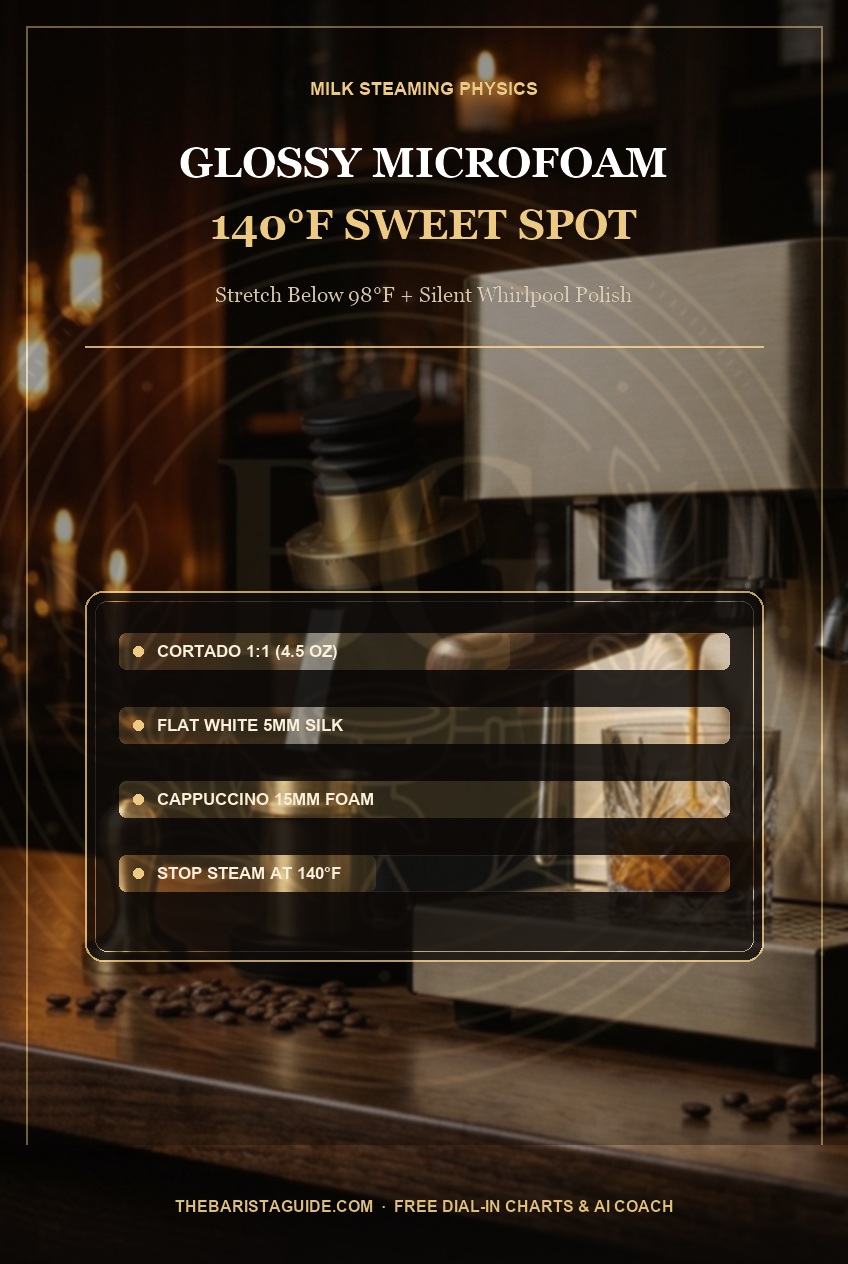
- Shut off your steam wand at 140°F–145°F (when the steel pitcher becomes 1 second too hot to hold); past 158°F, whey proteins denature and smell like boiled egg!
One Double Shot, Five Iconic Café Classics
Walk into any serious specialty coffee bar from Melbourne to Madrid and you will discover a comforting secret: the barista isn't pulling five different espresso shots behind the counter. Every signature milk drink on the board builds outward from one calibrated 36g–38g double espresso—differentiated strictly by cup volume and microfoam aeration depth.
The Specialty Milk Drink Ratio & Vessel Blueprint
| Café Drink | Total Cup Size | Espresso Base | Steamed Milk Mass | Microfoam Cap | Authentic Serving Vessel |
|---|---|---|---|---|---|
| Traditional Macchiato | 2.5 – 3.0 oz | 36g Double | 15g – 20g | 1 dollop glossy foam | 3 oz Ceramic Demitasse Cup |
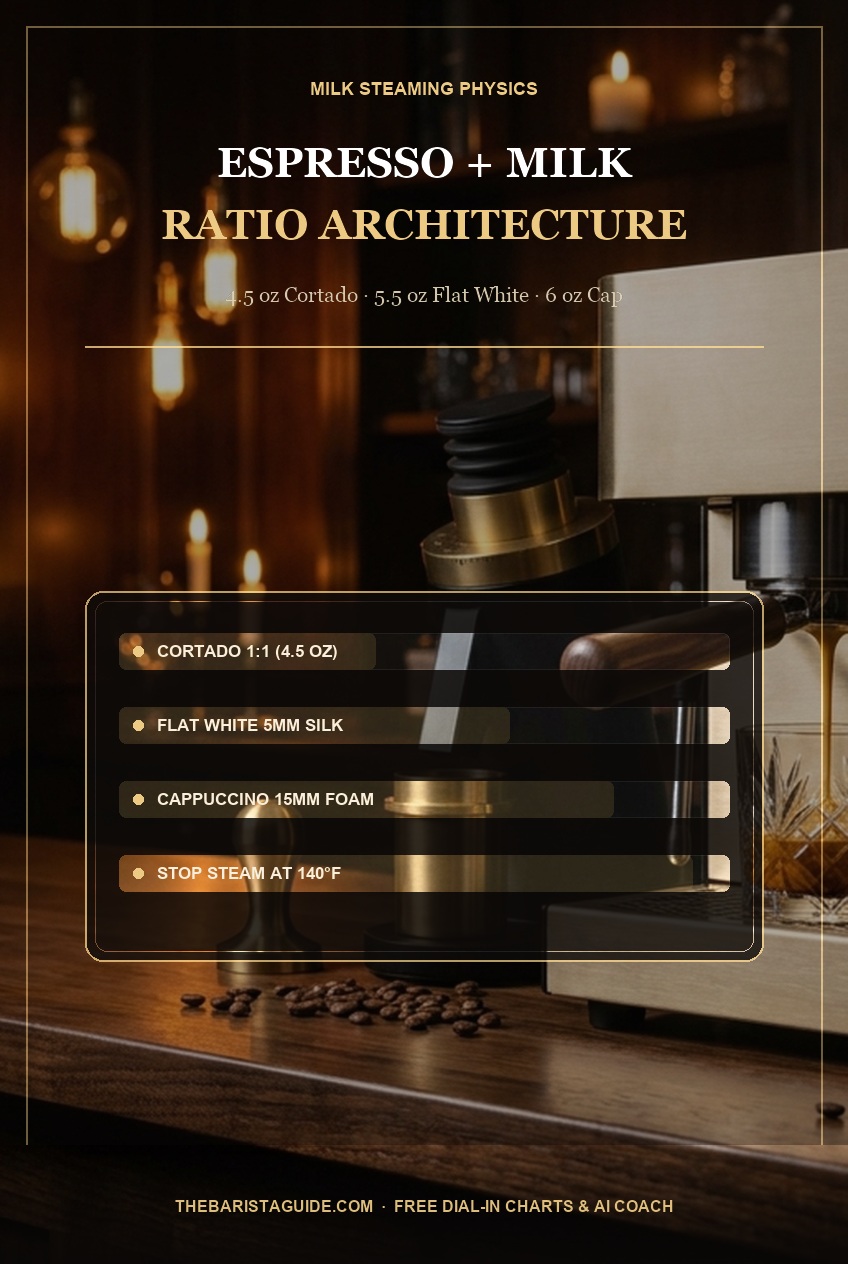
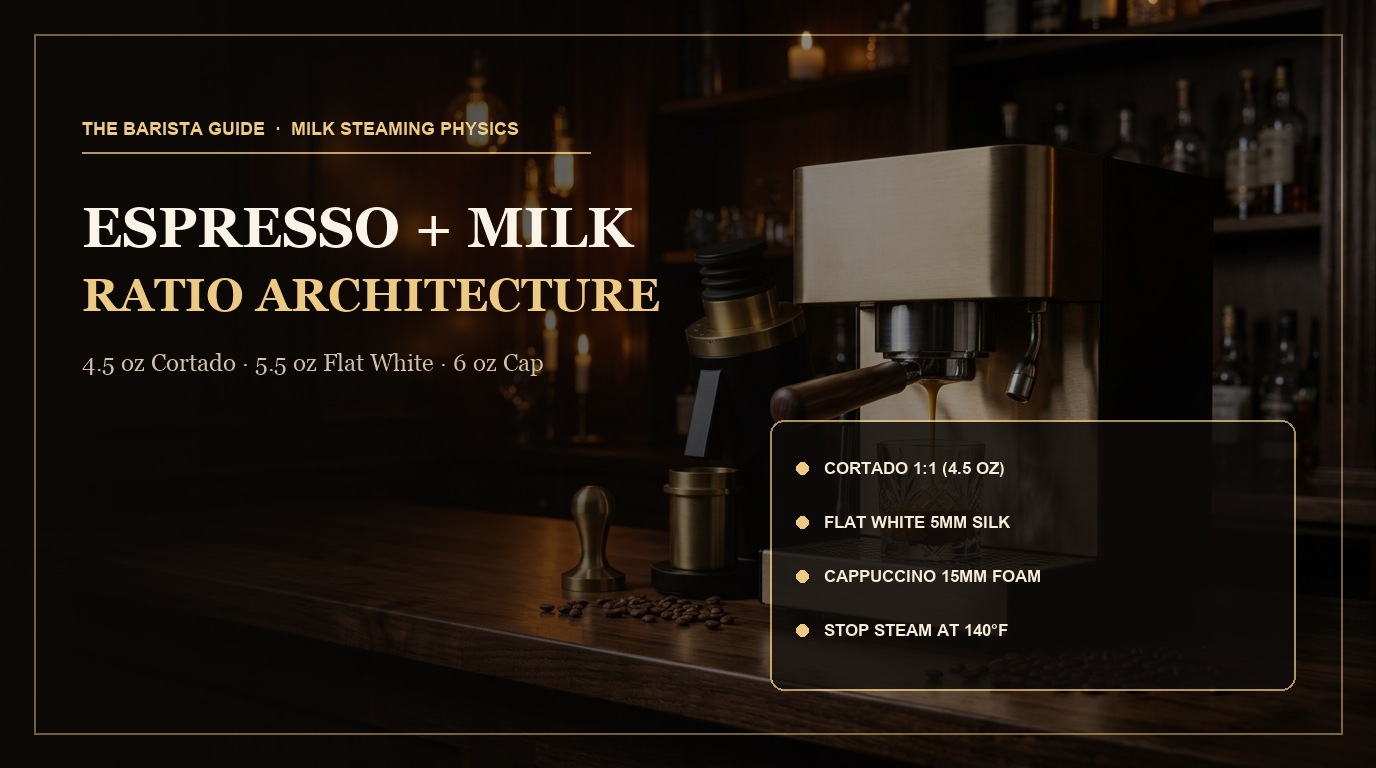
| Cortado / Gibraltar | 4.25 – 4.5 oz | 36g Double | 45g – 55g (1:1–1:1.5) | 2–3mm thin silk | 4.5 oz Libbey Gibraltar Rocks Glass |
| Flat White | 5.5 – 6.0 oz | 36g Double (or Ristretto) | 110g – 130g (1:3) | 5mm glossy wet paint | 6 oz Ceramic Flat White Tulip Cup |
| Specialty Cappuccino | 6.0 oz | 36g Double | 100g – 115g | 12–15mm velvety pillow | 6 oz Thick-Walled Porcelain Cup |
| Café Latte | 8.0 – 10.0 oz | 36g Double | 180g – 230g (1:5+) | 6–8mm microfoam | 8 oz Wide-Mouth Latte Art Bowl Cup |
The 2-Stage Pitching Physics for Glossy "Wet Paint" Microfoam
Forget plunging the wand up and down! Pour cold 38°F whole milk just up to the bottom V-base of the spout inside a chilled 12 oz / 15 oz Handleless or Sharp-Spout Milk Pitcher, purge condensation water from the wand for 2 seconds, and execute two strict phases:
- Phase 1 — Stretching / Aeration (
38°F → 98°F· First 3 to 6 Seconds): Rest the wand in the pitcher spout at a 15-degree off-center tilt with the steam tip 1mm below the surface. Turn steam full power. Listen for gentle "tss-tss-tss" paper-tearing whispers (3 seconds for a Cortado/Flat White, 6 seconds for a Cappuccino). The instant the steel pitcher wall feels lukewarm against your palm (98°F), stop adding air! - Phase 2 — Texturing / Whirlpool Polish (
98°F → 140°F): Raise the pitcher 3mm to submerge the tip silently while holding the off-center tilt so a silent, vigorous whirlpool vortex folds larger surface bubbles down into microscopic silk. Shut steam off the exact second the pitcher becomes too hot to hold comfortably for more than 1 second (140°F / 60°C).
Tap the pitcher base once on the counter, swirl until the milk shines like melted white chocolate, tilt your espresso cup 40 degrees, pour high in the center to sink beneath the crema, then drop the spout right down to the liquid surface to float your white heart or tulip! Want steamed-quality microfoam alongside an AeroPress or Moka Pot without a boiler? The Subminimal NanoFoamer PRO Gen-2 Automatic Microfoam Maker spins true vortex latte-art milk on any countertop.
Barista-Tested Gear & Roast Provisions
- Precision Latte Art Pitcher: Normcore Handleless Silicone-Sleeve 15.2 oz Milk Pitcher — Direct finger-to-spout control + heat-shield grip for effortless tulip symmetry.
- Cortado Standard Glass: Libbey DuraTuff 4.5 oz Gibraltar Cortado Glasses (Set of 4/6) — The exact octagonal tempered glass invented in San Francisco cafés for the Gibraltar/Cortado.
- Competition Porcelain: Heavy-Walled 6 oz & 8 oz Round-Bottom Latte Art Cups — Parabolic interior bowl rolls espresso crema smoothly without breaking contrast lines.
- No-Machine Microfoam: Subminimal NanoFoamer PRO Gen-2 Microfoam Jug — Creates true pourable wet-paint microfoam fromdairy or oat milk without a steam wand.
- Training Thermometer: Clip-On Instant-Read Barista Milk Frothing Thermometer — Calibrates your palm muscle memory to the 140°F lactose sweet spot in one weekend.
- Wand Microfiber Cloths: 4-Pack Waffle-Weave Barista Microfiber Steam Wand Towels — Dedicate one damp towel strictly to immediate post-steam wand wiping.
Instant Coffee Grinder Setting & Dial-In Lookup
Frequently Asked Calibration Questions
What is the real difference between a Cortado and a Flat White?
Ratio and vessel! A Cortado ("cut" in Spanish) combines equal 1:1 parts double espresso (~38g) and lightly textured milk (~45g–55g) in a 4.5 oz faceted Gibraltar glass with ~3mm microfoam. A Flat White uses the same double shot stretched into a 5.5–6 oz ceramic tulip cup (~110g milk) crowned with a velvety 5mm microfoam canvas for rosetta art.
Which milk is easiest to learn latte art with—whole dairy, 2%, or oat?
Cold whole cow’s milk (3.25% butterfat, 8g protein) is the gold standard for training because milk proteins stabilize micro-bubbles while butterfat gives glossy fluid viscosity. Among plant milks, Oatly or Califia Barista Edition steams closest to dairy—just aerate 2 seconds longer and let it rest 10 seconds before swirling.
Why should I buy a 12 oz milk pitcher instead of using a giant 20 oz pitcher for one cortado?
Steaming less than 4 oz of milk inside a wide 20 oz pitcher leaves the liquid level too shallow to submerge the steam tip for a whirlpool! Match a compact 12 oz (350ml) pitcher to cortados/macchiatos and a 15–17 oz (450ml) pitcher to 6–8 oz lattes.
Quick-Reference Espresso & Brew Cheat Cards