Washed Ethiopian vs. Natural Brazilian Coffee: How Bean Density & Elevation Dictate Dial-In
Why does a 2,100m washed Yirgacheffe gusher at the exact grind setting where a 1,100m natural Brazil chokes? Master elevation density, processing solubility, and PID temps.
Reader-Supported Lab Note: When you buy gear or whole beans via links in this guide, we may earn an affiliate commission at zero extra cost to you. As an Amazon Associate I earn from qualifying purchases. Learn more.
⚡ 60-Second Barista Takeaways
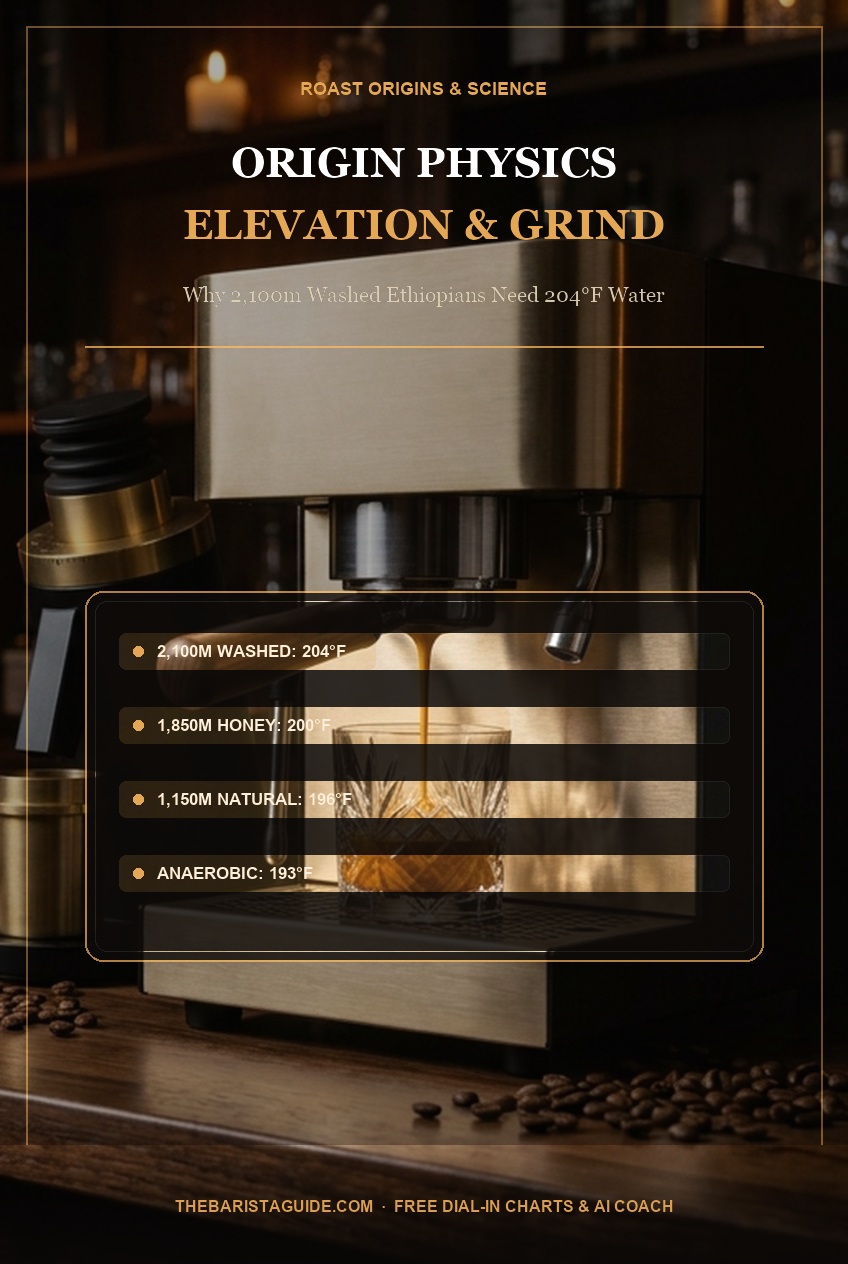
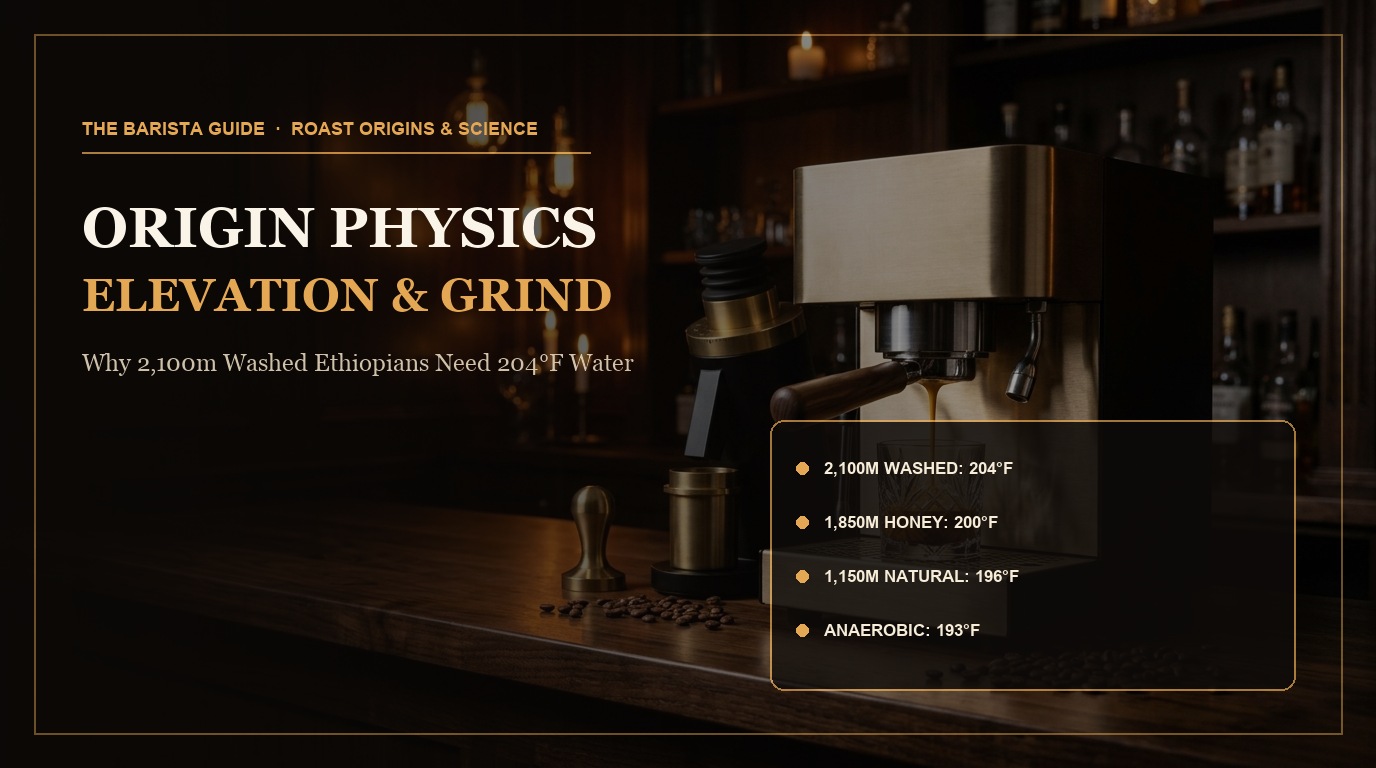
- Cool mountain nights above 1,800 MASL slow coffee cherry maturation, packing dense cellular structures that resist extraction—demanding higher water temps (203°F–205°F) and longer ratios.
- Washed Ethiopian Heirloom varieties shatter into extra micro-fines inside burrs—stalling V60 filters while simultaneously flowing fast in espresso!
- Natural, Honey, and Anaerobic processed beans have degraded, porous cell walls that extract easily—drop water temperature 3°F–5°F to preserve sweet fruit without boozy astringency.
Stop Treating All "Medium Roast" Bags Identically
Nothing frustrates a home barista faster than finishing a forgiving bag of 1,150m Natural Brazil Cerrado (pulling dreamy 29-second chocolate shots at Setting 15), pouring in a fresh bag of 2,150m Washed Ethiopian Yirgacheffe without touching the grinder, and watching thin, sour lemon juice rocket through the portafilter in 14 seconds flat.
Roast color is only half of the solubility equation. Before a green coffee seed ever enters a drum roaster, growing elevation (MASL) and post-harvest processing dictate cellular porosity, shatter mechanics inside steel burrs, and ideal PID water temperature.
The Origin, Elevation & Processing Dial-In Matrix
Next time you open a specialty bag—or scan it with our free AI Coffee Bag & Dial-In Coach—adjust your baseline using these four archetypes:
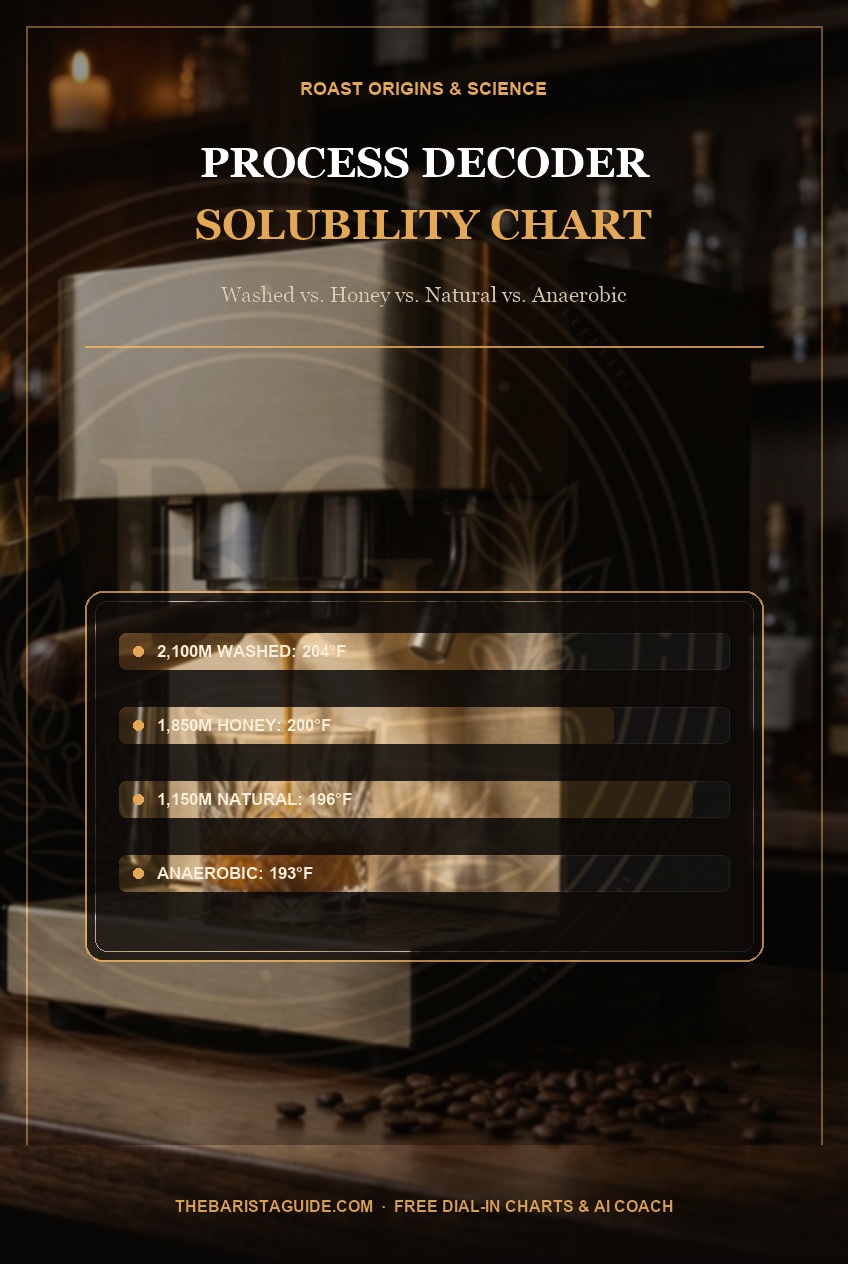
| Origin & Processing Archetype | Cellular Density | Espresso Ratio & PID Temp | V60 Pour-Over Temp & Strategy | Flavor Signature | Bean Provision Match |
|---|---|---|---|---|---|
| Washed Ethiopia / Kenya (1,900–2,200m) | Ultra-Hard (Brittle; high V60 fines) | 1:2.3 – 1:2.5 at 204°F · Finer grind | 205°F · Gentle center pour + fast filter | Jasmine, bergamot, white peach, blackcurrant | Fresh Roasted Ethiopian Yirgacheffe Whole Bean |
| Honey / Washed Colombia & Costa Rica (1,650–1,950m) | Medium-High (Balanced solubility) | 1:2.0 – 1:2.2 at 201°F · Baseline grind | 201°F · Standard 2-pulse concentric pour | Red apple, panela cane sugar, milk chocolate | Colombian Huila Specialty Whole Bean Coffee |
| Natural Brazil / Sumatra Wet-Hulled (900–1,350m) | Low-Medium (Soft, porous cell walls) | 1:1.75 – 1:2.0 at 197°F · Coarser | 195°F · Coarser grind to avoid nutty dryness | Roasted hazelnut, peanut butter cup, low acid | Brazil Cerrado Natural Whole Bean Espresso |
| Anaerobic / Thermal Shock Co-Ferments | Hyper-Soluble (Fermentation breaks cells) | 1:2.0 at 195°F · Coarser than expected | 192°F · Low agitation 1:15 brew | Strawberry jam, tropical wine, cinnamon | Cafec Abaca Fast-Flow V60 Filters |
Solving the "Ethiopian Fines Paradox" on V60 vs. Espresso
Why does the exact same washed Ethiopian bean flow too fast in 9-bar espresso yet clog to a standstill in a V60 paper cone?
- In V60 Percolation (Gravity Only): Dense high-elevation seeds shatter into a bimodal spike of tiny
<90 μmdust particles. Swirling aggressively washes those micro-fines straight into the paper pores, choking drawdown past 4:30. The Fix: Swap standard thick tabbed papers for Cafec Abaca Cone Paper Filters and pour gently with a Fellow Stagg EKG Pro Gooseneck Kettle. - In 9-Bar Espresso: Lightly roasted high-elevation beans retain far less roast-generated CO2 gas and resist water swelling, offering very little puck back-pressure. The Fix: Grind 2–3 micro-clicks finer on a DF64 Gen 2 or 1Zpresso J-Ultra and stretch output to
18g in → 42g out.
Barista-Tested Gear & Roast Provisions
- Floral Washed Benchmark: Fresh Roasted Coffee Organic Ethiopian Yirgacheffe Whole Bean — Classic high-elevation bergamot and lemon-blossom clarity for testing V60 and turbo shots.
- Chocolate Crema Benchmark: Peet's Coffee Major Dickason's / Espresso Forte Whole Bean — Rich, low-elevation-friendly body built for milk cortados and cappuccinos.
- Anti-Stall Filter Paper: Cafec Abaca Size 02 Cone Paper Filters (100-Count) — Two-sided crepe weave prevents dense African micro-fines from choking V60 beds.
- 1°F PID Control: Fellow Stagg EKG Pro Electric Gooseneck Kettle — Effortlessly switch between 205°F washed Kenya pours and 193°F anaerobic naturals.
- Unimodal Clarity Grinder: Fellow Ode Brew Grinder Gen 2 (64mm Flat Burrs) — Slashes fine-particle shatter on dense high-altitude beans.
- Origin Tasting Cups: Kruve Propel / Sensory Double-Walled Tasting Glasses — Flared headspace rim amplifies floral aromatics during side-by-side origin flights.
Instant Coffee Grinder Setting & Dial-In Lookup
Frequently Asked Calibration Questions
Why does washed Ethiopian coffee clog my V60 filter past 4 minutes even at a medium grind?
Ultra-dense 2,000m+ Ethiopian Heirloom beans are brittle like glass and fracture into twice as many microscopic fines (<100μm) as softer Latin American varieties. Avoid aggressive swirling after your bloom, pour gently in the center, and switch to fast-flowing Cafec Abaca paper filters!
Why do decaf espresso beans suddenly run twice as fast or require super-fine grinds?
Swiss Water and Ethyl Acetate (Sugarcane EA) decaffeination steam-strips caffeine out of green beans before roasting, leaving highly porous, brittle cellular walls that degas CO2 within days and offer minimal hydraulic puck resistance—grind 3–5 clicks finer and drop brew temp to 196°F.
How can I read any coffee bag label and get an instant grind & temp prescription?
Snap a photo of any specialty bag on our free /scan AI Coffee Bag & Shot Coach—it reads elevation, roast level, and processing method directly off the label and calculates exact clicks for your specific grinder.
Quick-Reference Espresso & Brew Cheat Cards